Description
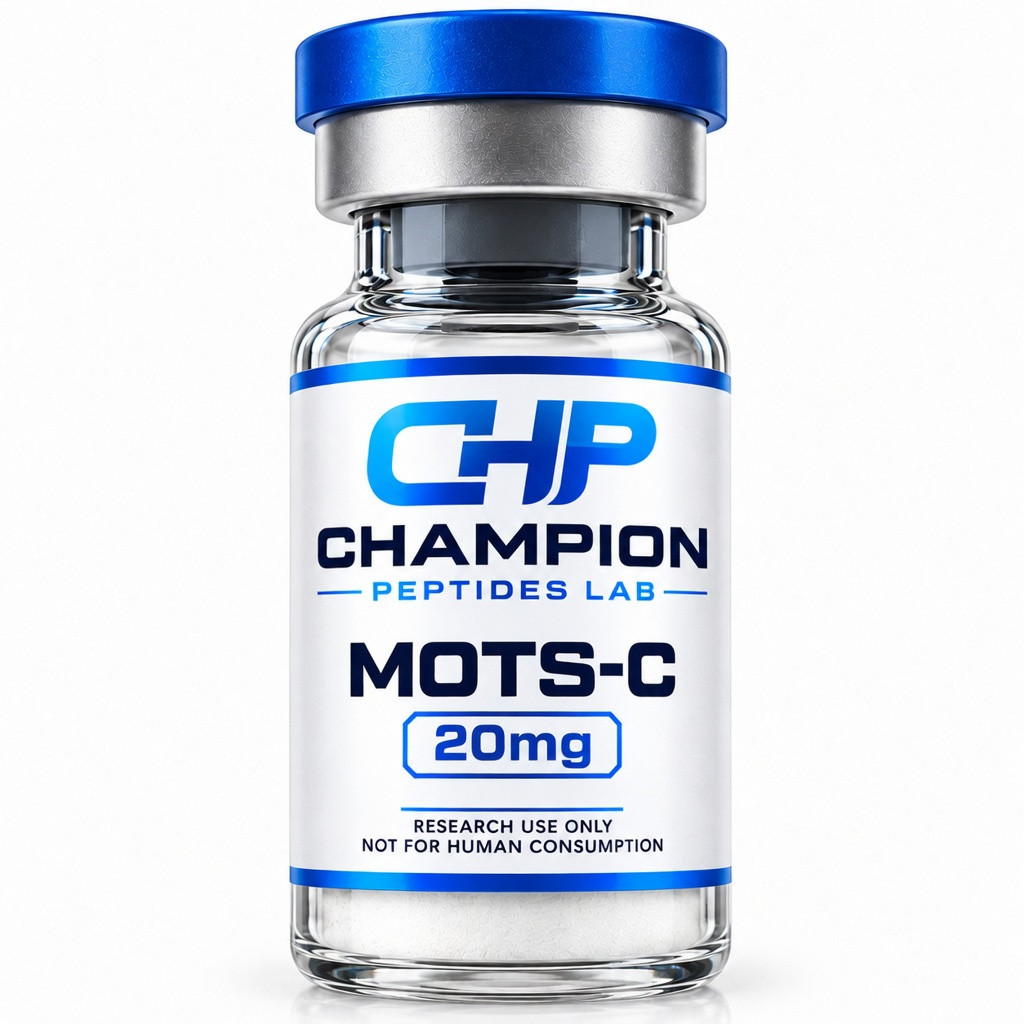
Champion Peptides Premium MOTS-c | High-Purity Mitochondrial Research Peptide (5mg & 10mg)
Step into the frontier of mitochondrial science with Champion Peptides’ top-grade MOTS-c. Crafted for precise purity and structural stability, our MOTS-c stands as a dependable choice for researchers aiming to study metabolic regulation, cellular energy dynamics, and longevity science.
The Science of Mitochondrial Regulation: Introducing MOTS-c
Mitochondria have long been known as the cellular powerhouses responsible for generating adenosine triphosphate (ATP). However, modern molecular biology shows these organelles also act as critical signaling hubs communicating directly with the cell nucleus to regulate systemic balance. At the heart of this network lie mitochondrial-derived peptides (MDPs), biological molecules encoded straight within the mitochondrial genome.
Among these, MOTS-c (Mitochondrial Open Reading Frame of the 12S rRNA-c) emerges as a potent, 16-amino acid peptide regulating metabolic flexibility, insulin sensitivity, and lifespan markers. First identified in 2015, MOTS-c acts as an endocrine-like signaling molecule. Unlike nuclear-encoded peptides, MOTS-c is synthesized inside the mitochondria, moves to the cell nucleus during metabolic stress, and directly shapes nuclear gene expression to restore energetic equilibrium.
For researchers pursuing the deep implications of mitochondrial signaling on metabolic health, finding a reliable source matters. When searching to buy MOTS-c online, laboratory standards demand a product free from contaminants, TFA (trifluoroacetic acid) residues, and structural breakdown. Champion Peptides supplies top-tier MOTS-c built specifically to meet these stringent scientific standards, ensuring your experimental models produce accurate, reproducible, and trustworthy data.
Cellular Mechanisms and Signaling Pathways
To grasp the physiological potential of MOTS-c, researchers must analyze its complex intracellular pathways. The peptide functions through distinct mechanisms setting it apart from traditional metabolic regulators.
Activation of the AMPK Pathway
One primary mechanism involves the activation of AMP-activated protein kinase (AMPK). AMPK acts as the master regulator of energy homeostasis, sensing shifts in the ratio of AMP to ATP. When cellular energy drops, AMPK undergoes phosphorylation, starting a chain reaction that downregulates energy-consuming pathways like lipid synthesis while upregulating energy-producing pathways such as fatty acid oxidation and glucose uptake.
MOTS-c promotes AMPK activation by inhibiting the folate cycle, causing an accumulation of 5-aminoimidazole-4-carboxamide ribonucleotide (AICAR). AICAR serves as a natural activator of AMPK. By stimulating this route, MOTS-c increases glucose uptake in skeletal muscle cells independently of insulin signaling pathways, making it a focal point for studying insulin resistance and metabolic dysfunction.
Mitochondrial Biogenesis and Cellular Homeostasis
Mitochondrial decay signals aging and metabolic decline. MOTS-c promotes mitochondrial biogenesis—the formation of new mitochondria inside the cell. It accomplishes this by turning on key transcription factors, including Peroxisome proliferator-activated receptor-gamma coactivator 1-alpha (PGC-1α) and Nuclear Respiratory Factor 1 (NRF-1).
By boosting mitochondrial density and improving network integrity, MOTS-c maintains the NAD+/NADH ratio, cuts down reactive oxygen species (ROS) accumulation, and preserves metabolic flexibility—the cell’s capacity to switch between burning carbohydrates and fats for fuel.
Insulin Sensitivity and Glucose Metabolism
In skeletal muscle, MOTS-c noticeably improves glucose clearance. It aids the movement of Glucose Transporter Type 4 (GLUT4) vesicles to the cell membrane, allowing glucose entry even where insulin receptors are desensitized. MOTS-c stops the buildup of sphingolipids and diacylglycerols, toxic lipid intermediates known to disrupt proximal insulin signaling. This dual action positions MOTS-c as a strong research tool for investigating Type 2 Diabetes, obesity, and metabolic syndrome.
Primary Research Applications and Benefits of MOTS-c
The biological traits of MOTS-c drive its adoption across various scientific fields. Researchers apply our MOTS-c to study diverse physiological systems and pathological conditions.
Enhancement of Metabolic Rate and Lipid Oxidation
In animal models of diet-induced obesity, MOTS-c shows a notable ability to limit weight gain and fat accumulation without altering calorie intake. This happens mainly through turning on thermogenic pathways in brown adipose tissue (BAT) and browning white adipose tissue (WAT). Researchers studying lipid metabolism use MOTS-c to track changes in fatty acid beta-oxidation, plasma lipid profiles, and hepatic steatosis.
Physical Endurance, Stamina, and Athletic Capacity
Often called an exercise mimetic in literature, MOTS-c mirrors many benefits of physical training. During exercise, natural MOTS-c levels spike in skeletal muscle and systemic circulation. When researchers apply exogenous MOTS-c in models, it boosts physical performance, running capacity, and grip strength. It optimizes oxygen use, slows lactic acidosis, and speeds up post-exercise cellular recovery.
Longevity, Cellular Senescence, and Anti-Aging Research
As organisms age, mitochondrial function drops, triggering cellular senescence, chronic inflammation, and tissue decline. Studies show systemic MOTS-c levels drop significantly with age. By restoring youthful levels of this peptide, researchers notice a reversal of age-linked metabolic decline, better physical resilience, and longer lifespans in animal models. MOTS-c forms a core pillar in modern geroscience.
Bone Mineral Density and Osteogenesis
Recent studies indicate MOTS-c supports bone health. It aids bone marrow stem cell differentiation into osteoblasts while stopping osteoclastogenesis. This dual effect makes MOTS-c a fascinating topic for studies on osteoporosis, osteopenia, and age-related bone loss.
The Champion Peptides Quality Standard
In high-level science, chemical purity is non-negotiable. Substandard peptides with high trifluoroacetate (TFA) salts, bacterial endotoxins, or isomers can ruin cellular assays, skew in vivo data, and cause failed experiments. Champion Peptides stands out as a top MOTS-c supplier because we hold firm on quality control.
Uncompromising Purity and Analytical Testing
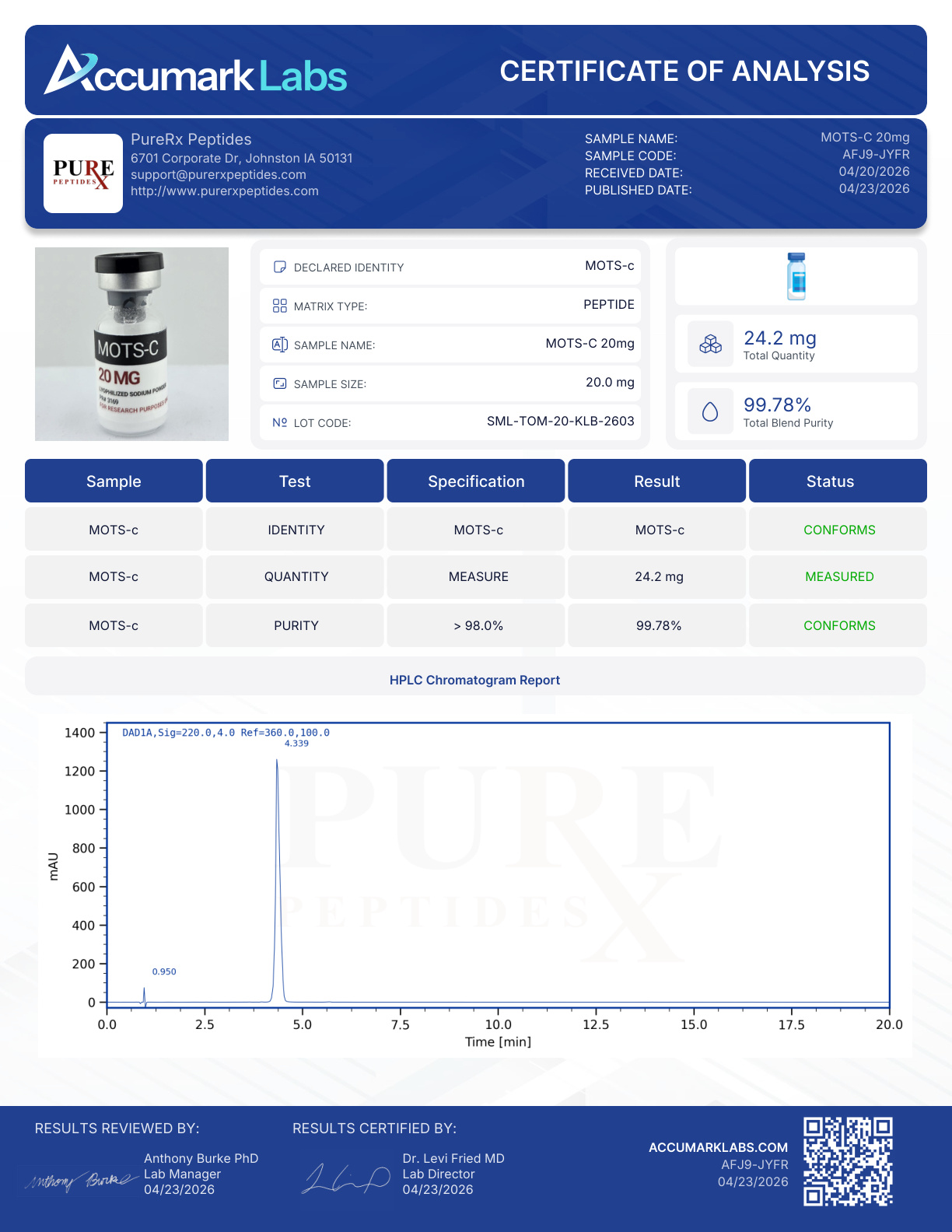
Every batch of MOTS-c from Champion Peptides undergoes strict analytical checks. We use High-Performance Liquid Chromatography (HPLC) to verify purity, ensuring it hits or exceeds 99%.
Mass Spectrometry (MS) confirms exact molecular weights and amino acid sequences, guaranteeing zero synthesis errors or short sequences. We supply thorough, batch-specific Certificates of Analysis (CoA) with every order for total research transparency.
Lyophilization and Vacuum Sealing
Peptides easily suffer from hydrolytic breakdown, oxidation, and enzymatic cleavage. To protect our MOTS-c, we use advanced freeze-drying (lyophilization) methods. This pulls all moisture from the vial while keeping the peptide structure stable. Each vial is vacuum-sealed under an inert nitrogen blanket to block oxidation and moisture during storage and transit.
Choosing the Right Variation: 5mg vs. 10mg
To fit different experimental scopes, budgets, and protocols, Champion Peptides supplies MOTS-c in two practical sizes: 5mg and 10mg vials.
MOTS-c 5mg Vial
The 5mg vial works well for pilot studies, cell culture assays, or small animal cohorts like mice or rats.
- Best For: Short-term tests, initial dose curves, and sensitive cell assays.
- Advantages: Reduces waste by letting researchers mix smaller peptide amounts at once. This helps since reconstituted liquids degrade faster than dry powders.
- Cost Efficiency: Offers a lower entry cost, helping labs spread budgets across multiple controls.
MOTS-c 10mg Vial
The 10mg vial suits high-throughput screening, long studies, or large animal models needing higher cumulative doses.
- Best For: Chronic administration protocols and large-scale cohorts.
- Advantages: Delivers better economic value. The price per milligram drops when buying the 10mg size, maximizing grant funds.
- Convenience: Lowers vial-to-vial variation across long studies by allowing bigger stock solutions to be made at once.
Reconstitution, Storage, and Handling Guidelines
To keep your MOTS-c effective, follow strict sterile handling, mixing, and storage rules.
Reconstitution Protocols
MOTS-c is a lyophilized powder requiring mixing with a sterile liquid before use. For most lab work, Sterile Bacteriostatic Water (0.9% benzyl alcohol) works best since benzyl alcohol stops bacterial growth.
1. Temperature Equilibrate: Let the vial reach room temperature before mixing. Cold liquid on warm powder causes thermal shock and ruins bonds.
2. Sanitize: Clean the rubber stopper with an isopropyl alcohol swab and let it dry.
3. Introduce Diluent: Draw the right amount of bacteriostatic water using a sterile syringe. Slowly inject it down the inner glass wall. Never spray liquid straight onto the powder cake.
4. Dissolve Gently: Avoid shaking or vigorous mixing. Shaking causes shear stress that ruins the peptide structure. Instead, swirl the vial gently or roll it between your palms until clear.
Storage Conditions
Proper storage stops peptide breakdown over time.
- Lyophilized Powder (Unopened): Store in a freezer at -20°C (-4°F) or lower. The dry peptide stays stable for up to 24 months. Short storage under 3 months in a fridge at 2°C to 8°C works fine.
- Reconstituted Solution (Opened): Store mixed solutions in a fridge at 2°C to 8°C. Never refreeze after mixing because ice crystals shear the molecules. Use reconstituted MOTS-c within 14 to 21 days.
- Light Protection: Peptides are sensitive to UV rays. Keep vials in dark spaces away from direct sunlight and bright lab lights.
Product Specifications and Key Features
- Product Name: MOTS-c (Mitochondrial Open Reading Frame of the 12S rRNA-c)
- Molecular Formula: C101H152N28O22S2
- Molecular Weight: 2174.6 g/mol
- Sequence: Met-Arg-Trp-Gln-Glu-Met-Gly-Tyr-Ile-Phe-Leu-Pro-Arg-Lys-Leu-Arg (MRWQEMGYIFLPRKLR)
- Purity: ≥99.0% via HPLC and Mass Spectrometry
- Physical State: Lyophilized white powder
- Variations: 5mg and 10mg sterile vacuum-sealed vials
- Formulation: Free of fillers or preservatives
- Source: Solid-phase peptide synthesis (SPPS)
- Intended Use: Laboratory research and in vitro/in vivo tests only
Purchasing Guide and Frequently Asked Questions
What is MOTS-c used for in laboratory research?
In labs, MOTS-c studies metabolic regulation, cellular energy, mitochondrial signals, and aging. Researchers look at AMPK activation, glucose uptake, lipid oxidation, and age-related metabolic decline in models.
How do I buy MOTS-c online safely?
Buy MOTS-c online only from trusted suppliers like Champion Peptides. Look for vendors supplying verified HPLC and Mass Spectrometry reports. Avoid sellers lacking analytical tests or offering unrealistically low prices.
What factors influence the MOTS-c price?
Price depends on raw material quality, synthesis methods, purity levels, and strict testing needed to ensure 99% purity. Buying larger sizes like 10mg vials lowers the cost per milligram.
What is the shelf life of Champion Peptides MOTS-c?
Unopened dry powder stored at -20°C lasts up to two years. Fridge storage at 2°C to 8°C keeps unopened powder safe for 3 months. Use mixed solutions within 14 to 21 days.
How does MOTS-c compare to other mitochondrial peptides?
MOTS-c is unique since it comes from the 12S rRNA region and moves to the nucleus during stress. Other peptides like Humanin focus on cell survival and anti-apoptotic pathways, while MOTS-c drives metabolic rate and insulin sensitivity.
Why is Champion Peptides considered the best MOTS-c supplier?
Champion Peptides earns trust through strict quality checks, HPLC and MS analysis on every batch, and secure vacuum-sealed packaging. Our fast, temperature-controlled shipping keeps compounds intact.
Can MOTS-c be used in human clinical trials?
The MOTS-c sold here is meant strictly for lab research and animal studies. It is not approved for human consumption or medical use.
How should I calculate the volume of diluent for reconstitution?
Diluent volume depends on your target concentration. For a 10mg vial aiming at 5mg/mL, add 2.0 mL of bacteriostatic water. Always label mixed vials with concentration and date.
What is the shipping policy for lyophilized peptides?
Our freeze-dried peptides stay stable during transit. We pack shipments securely and offer fast shipping options. Place vials straight into cold storage upon arrival.
Secure Your Order of Premium MOTS-c Today
When you order MOTS-c from Champion Peptides, you invest in scientific accuracy, consistency, and reliability. Your research depends on material quality, which is why every vial faces tough testing standards. Explore our 5mg and 10mg options, enjoy fair pricing, and see what top-grade research peptides do for your lab results.


There are no reviews yet.