Description
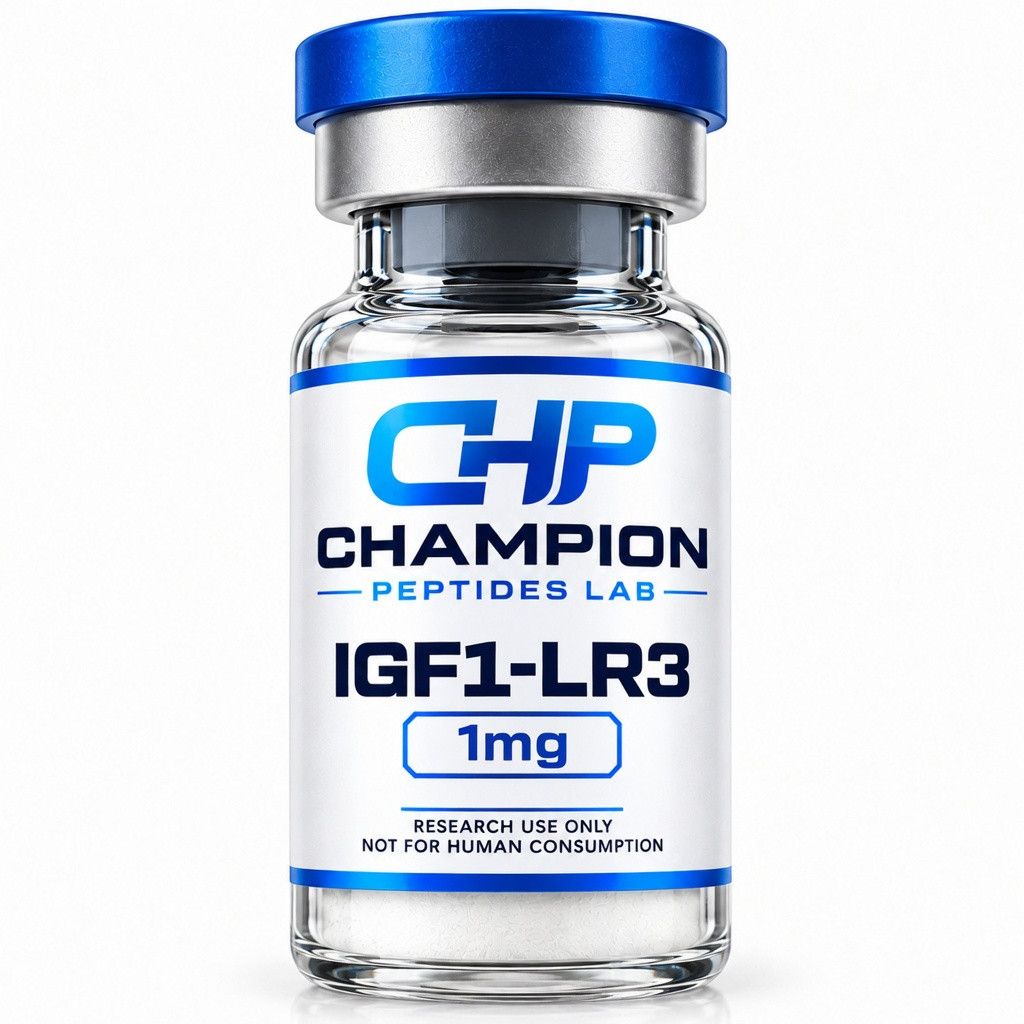
Champion Peptides Premium IGF-1 LR3 (5mg & 10mg) – Ultra-Pure Research Grade
Access deep cellular development, faster tissue recovery, and advanced structural research with some of the highest quality IGF-1 LR3 on the market today. Champion Peptides offers this ultra-pure, lyophilized peptide in highly stable 5mg and 10mg vials. These are custom-made to meet the rigorous demands of serious laboratory studies and clinical research models.
The Primary Research Catalyst for Cellular Growth and Tissue Regeneration
In advanced biochemical research, precision is everything. We know this. Champion Peptides offers premium IGF-1 LR3—a highly potent, modified analog of Insulin-like Growth Factor-1. It is specifically designed to bypass binding proteins. This allows it to deliver maximum biological activity. Your lab might focus on cellular hyperplasia, protein synthesis pathways, or musculoskeletal tissue repair. Our IGF-1 LR3 provides the structural integrity and consistent purity needed to yield reliable, reproducible experimental data. Every time.
Many researchers looking for IGF-1 LR3 for sale struggle to find a source that guarantees both high purity levels and structural stability. At Champion Peptides, we eliminate the guesswork. It is that simple. Every single batch of our premium IGF-1 LR3 undergoes strict testing. We use High-Performance Liquid Chromatography (HPLC) and Mass Spectrometry (MS) analysis to ensure a purity rating exceeding 98%. When you buy IGF-1 LR3 online from us, you invest in a product manufactured under strict cGMP guidelines. It is built to lift your research to its highest potential.
Understanding the Science of IGF-1 LR3
To see the value of our premium IGF-1 LR3, you must understand its structural modifications. It differs from endogenous Insulin-like Growth Factor-1 in key ways. Standard IGF-1 is a highly anabolic hormone. The liver produces it in response to Growth Hormone (GH) stimulation. It plays a major role in childhood growth. It also mediates anabolic processes in adults. However, native IGF-1 has a big limitation in lab settings—a very short half-life of only about 10 to 20 minutes. This happens because it binds quickly to IGF-Binding Proteins (IGFBP).
IGF-1 LR3 (Insulin-like Growth Factor-1 Long Arg3) is a synthetic, single-chain recombinant human peptide. It has 83 amino acids. Natural IGF-1 has only 70. This analog incorporates two distinct structural modifications:
- The Glu3 to Arg3 Substitution: The glutamic acid residue at position 3 is replaced with an arginine residue.
- The N-Terminal Extension: A 13-amino-acid extension peptide is added to the N-terminus.
These precise molecular changes reduce the peptide’s affinity for human IGF-binding proteins (IGFBPs) by up to 120-fold. Normally, IGFBPs bind to and deactivate IGF-1. This structural bypass allows IGF-1 LR3 to remain free. It stays active in systemic circulation for a much longer time. Standard IGF-1 is cleared within minutes. In contrast, IGF-1 LR3 boasts an extended half-life of roughly 20 to 30 hours. This prolonged activity makes it an incredibly efficient tool. It is perfect for studying long-term cellular processes, receptor activation, and tissue development. You do not need constant, repetitive dosing in your experimental models.
Primary Research Applications and Biological Pathways
The structural design of IGF-1 LR3 is unique. It binds to the Type 1 IGF Receptor (IGF-1R) with high affinity. This triggers a cascade of internal signaling pathways. These pathways govern cell growth, survival, and differentiation. Researchers who order IGF-1 LR3 online usually focus on a few key physiological mechanisms.
Hyperplasia vs. Hypertrophy
Traditional growth factors mainly promote hypertrophy—the enlargement of existing cells. IGF-1 LR3 is different. Scientists study it for its ability to induce hyperplasia. Hyperplasia means the creation of entirely new cells. In skeletal muscle research, this happens by activating satellite cells. These are the stem cells responsible for muscle growth and repair. By stimulating satellite cells to multiply and fuse with existing muscle fibers, IGF-1 LR3 helps create brand new muscle fibers. This offers a major area of study for muscle wasting diseases, sarcopenia, and physical trauma recovery.
Protein Synthesis and Nitrogen Retention
IGF-1 LR3 starts cell signaling through the Phosphoinositide 3-kinase (PI3K) / Akt pathway. Once active, this pathway turns up the Mammalian Target of Rapamycin (mTOR). This is the main regulator of protein synthesis. This cascade speeds up how amino acids build new structural proteins. At the same time, it stops protein breakdown. Researchers using our premium IGF-1 LR3 notice clear increases in cellular nitrogen retention. This serves as a main marker for anabolism and tissue growth.
Enhanced Nutrient Partitioning and Glucose Transport
It is structurally distinct from insulin. Yet, IGF-1 LR3 shares a high level of sequence similarity with it. It can even interact with insulin-IGF-1 hybrid receptors. This allows the peptide to help GLUT4 move to cell membranes. This process significantly boosts the uptake of glucose and amino acids directly into muscle cells. This nutrient-partitioning effect shifts energy away from fat tissue. Instead, it sends it straight to skeletal muscle and connective tissues. This supports cellular energy production and quick recovery during metabolic studies.
Connective Tissue and Collagen Synthesis
Beyond skeletal muscle applications, IGF-1 LR3 is highly useful in orthopedic research. It stimulates the growth of chondrocytes (cartilage cells) and osteoblasts (bone-forming cells). It also supports collagen synthesis in tendons and ligaments. This makes it an invaluable compound. Researchers use it to investigate faster healing protocols for joint injuries, tendonitis, and degenerative bone conditions.
Choosing Your Option: 5mg vs. 10mg Vials
We want to support different research scales and budgets. That is why Champion Peptides offers IGF-1 LR3 in two sizes—5mg and 10mg lyophilized vials. Picking the right one depends entirely on your needs. Think about the scope, duration, and concentration requirements of your specific research protocols.
IGF-1 LR3 5mg Vials
The 5mg option works best for small pilot studies, short-term experiments, or setting baseline parameters for your assays. This size allows for precise dosing with minimal waste. You only mix what you need for immediate testing. It is also a smart, budget-friendly starting point. Independent researchers can check the high quality of our peptides before scaling up their work.
IGF-1 LR3 10mg Vials
For larger, long-term, or high-throughput studies, our 10mg vials offer the best efficiency. Buying the 10mg option lowers the overall price per milligram. This makes it the preferred choice for established labs and multi-subject animal studies. A larger quantity ensures you have a steady supply from the exact same batch. This reduces variables and keeps your experiments consistent.
We prepare both options using advanced freeze-drying (lyophilization) technology. This process removes moisture while protecting the delicate peptide structure. It ensures maximum stability. The product can easily withstand transit temperatures and stay viable for long-term storage before you mix it.
Why Champion Peptides is the Leading IGF-1 LR3 Supplier
In the online peptide marketplace, quality control varies wildly. Many suppliers sell under-dosed, degraded, or contaminated products. These can ruin months of hard research. We wanted to solve this. Champion Peptides was started to provide a transparent, highly reliable source for premium IGF-1 LR3.
When you are deciding where to buy IGF-1 LR3, consider our quality guarantee:
- Verified Purity: Every batch is tested using HPLC and Mass Spectrometry. We confirm a purity level of 98% or higher. We do not hide behind vague claims. Our analytical data is readily available so you can verify the identity and structure of your peptide.
- Vacuum-Sealed Lyophilization: Our vials are freeze-dried and vacuum-sealed under sterile conditions. This prevents oxidation, degradation, and contamination. Your peptide arrives in pristine condition.
- Secure, Fast Shipping: Research timelines are strict—we know that. We package our peptides securely to protect them from light and physical damage during transit. We use rapid shipping methods to get them to your facility quickly.
- Superior Customer Support: Our support team is here to help. Contact us for order tracking, bulk pricing, or product details. We ensure a smooth, professional purchasing process from start to finish.
Key Features and Technical Specifications
- Product Name: IGF-1 LR3 (Insulin-like Growth Factor-1 Long Arg3)
- Molecular Formula: C400H625N111O115S9
- Molecular Weight: 9111.6 Da
- Purity: Greater than 98.0% as determined by HPLC analysis
- Appearance: Sterile filtered, white lyophilized (freeze-dried) powder
- Source: Recombinant synthesis, manufactured under cGMP guidelines
- Formulation: Lyophilized from a concentrated solution with no additives or preservatives
- Available Sizes: 5mg and 10mg vacuum-sealed glass vials
- Storage Conditions: Store lyophilized peptide at -20°C for long-term stability; keep reconstituted peptide refrigerated at 2°C to 8°C
Comprehensive Reconstitution and Storage Instructions
To keep your premium IGF-1 LR3 active, you must follow proper handling, reconstitution, and storage protocols. Peptides are highly sensitive to heat and physical shear forces. Careless preparation can easily damage the delicate amino acid chain.
Reconstitution Steps
To mix lyophilized IGF-1 LR3, researchers typically use a sterile, weak acid solution or bacteriostatic water. The peptide is highly hydrophobic. Because of this, we recommend a 0.6% acetic acid solution or sterile 10mM HCl for initial mixing. This prevents the peptide from sticking to the glass walls of the vial. Alternatively, bacteriostatic water with 0.9% benzyl alcohol works for short-term storage and immediate use.
1. Temperature Balance: Let the vial of lyophilized IGF-1 LR3 reach room temperature before mixing. This stops condensation from forming inside, which can degrade the peptide.
2. Clean the Vial: Gently wipe the rubber stopper with a sterile isopropyl alcohol swab. Let it air dry.
3. Add the Diluent: Draw up the right amount of your chosen liquid—usually 1ml or 2ml of bacteriostatic water or acetic acid.
4. Slow Addition: Insert the needle through the center of the rubber stopper. Aim it toward the glass wall of the vial, not directly at the dry powder. Slowly inject the liquid down the side of the glass. This avoids air bubbles and keeps the peptide safe from high-pressure impact.
5. Gentle Mixing: Once the liquid is inside, gently swirl the vial in a slow, circular motion. Never shake the vial. Shaking causes rapid physical forces that can destroy the peptide structure, making it inactive.
6. Full Dissolution: Let the vial sit quiet for 5 to 10 minutes. Wait until the powder is completely dissolved into a clear, colorless liquid. Check the liquid with your eyes for any floating particles before starting your experiment.
Long-Term and Short-Term Storage
Peptide stability depends heavily on storage temperatures:
- Lyophilized Powder (Dry): Keep the dry powder at -20°C to -80°C for long-term storage. At these ultra-low temperatures, the peptide stays stable and active for up to 24 months. For short-term storage under 3 months, a standard laboratory fridge at 2°C to 8°C works fine.
- Reconstituted Liquid: Once mixed, the peptide degrades easily. Keep the liquid solution in the fridge at 2°C to 8°C at all times. Do not freeze the mixed peptide. Repeated freeze-thaw cycles will break the peptide bonds and destroy its strength. For the best results, use the mixed solution within 30 days.
- Light Sensitivity: Keep both dry and mixed vials away from direct sunlight and strong UV light. Light speeds up the breakdown of amino acid chains.
Frequently Asked Questions & Purchasing Details
What is the difference between IGF-1 LR3 and IGF-1 DES?
Both are analogs of native IGF-1, but they have different modifications and uses. IGF-1 LR3 has an N-terminal extension and a single amino acid swap. This gives it a long half-life of 20 to 30 hours, making it perfect for systemic, long-term cell studies. In contrast, IGF-1 DES is a shorter peptide. It lacks the first three amino acids at the N-terminus. This gives IGF-1 DES a very short half-life of about 20 to 30 minutes, but it targets local receptors with high strength. Researchers choose IGF-1 LR3 for steady, systemic exposure. They choose IGF-1 DES for highly localized, short-term tissue analysis.
Why does the IGF-1 LR3 price vary so much between online suppliers?
The price of IGF-1 LR3 is tied directly to manufacturing standards, purity testing, and quality control. Cheap, low-grade peptides often come from poor facilities with minimal cleanup. This results in high levels of byproducts, heavy metals, or leftover solvents. These impurities can compromise your work and lead to erratic research results. Champion Peptides invests heavily in high-standard cGMP manufacturing and third-party analytical testing. We guarantee high-quality IGF-1 LR3 so you get a premium product that delivers consistent, reliable data every single time.
How should I calculate my reconstitution ratio?
The ratio depends on your desired concentration for research dosing. For example, if you have a 10mg vial of IGF-1 LR3 and mix it with 2ml of liquid, your concentration will be 5mg/ml (or 5,000mcg/ml). If you use 5ml of liquid, the concentration will be 2mg/ml (or 2,000mcg/ml). Using a standard concentration simplifies measuring micro-doses for cell cultures or animal models.
Is a prescription required to order IGF-1 LR3 online?
No. Because IGF-1 LR3 is sold strictly as a laboratory research chemical, you do not need a medical prescription to buy it. It is not meant for human use, therapy, or diagnostic work. When you buy from Champion Peptides, you agree to use this product only in a controlled laboratory environment. It is meant for scientific evaluation, in vitro assays, or animal research models in compliance with your local laws.
How can I verify that I am receiving the highest quality IGF-1 LR3?
We recommend always buying from a trusted, transparent supplier like Champion Peptides. Look for companies that provide batch-specific HPLC and Mass Spectrometry reports. These reports act as a fingerprint for the peptide. They prove its identity and exact purity. If a supplier cannot or will not give you these analytical documents, avoid them. Protect the integrity of your research.
What is the shipping policy for sensitive peptides?
At Champion Peptides, we take great care in preparing your order for transit. Our lyophilized peptides are stable at room temperature for short periods. They will not degrade during standard shipping times. Even so, we use heavy-duty, padded packaging to protect the glass vials from impact and environmental heat. Once we process your order, you get a tracking number. This lets you monitor progress and ensure prompt delivery to your laboratory.
Boost Your Scientific Discoveries with Champion Peptides
Do not let sub-par research materials stall your scientific progress. Invest in reliable, high-grade research peptides. Champion Peptides is a trusted online source for purchasing high-purity, laboratory-grade IGF-1 LR3. Whether you choose our efficient 5mg vials or our high-value 10mg option, you get a product that meets top standards of chemical synthesis and purity.
Speed up your cellular research, optimize your tissue regeneration studies, and achieve the clean experimental reproducibility that only premium-grade compounds can provide. Order your IGF-1 LR3 online today from Champion Peptides. See the difference that true quality makes in your lab.


There are no reviews yet.