Description
Premium AHK-Cu 100mg | High Purity Copper Peptide | Champion Peptides
Open up new pathways in cellular regeneration and hair follicle research with Champion Peptides’ premium AHK-Cu 100mg. This is a highly purified copper peptide complex. It is specifically built to stimulate dermal papilla cells, speed up extracellular matrix remodeling, and support advanced tissue-engineering studies. Developed under strict laboratory standards, this research-grade peptide offers outstanding stability and purity for both in vitro and in vivo experimental models.
The Science Behind AHK-Cu: Molecular Structure and Cellular Mechanisms
AHK-Cu is chemically known as L-Alanyl-L-Histidyl-L-Lysine copper complex. It belongs to the family of copper-binding peptides found naturally in human plasma. Specifically, it is a tripeptide conjugated with a divalent copper ion (Copper II). Copper itself is best. It is an essential transition metal required as a cofactor for numerous enzymatic reactions within mammalian biochemistry—including cellular respiration, antioxidant defense, and connective tissue formation.
Unlike other copper complexes, the specific amino acid sequence of AHK-Cu—Alanine-Histidine-Lysine—gives it a unique spatial conformation. It fits together perfectly. This precise molecular structure exhibits an exceptionally high affinity for copper ions, which allows for stable transport and localized delivery of copper directly to cellular receptors. In biological systems, AHK-Cu works mainly to modulate the activity of fibroblasts, endothelial cells, and dermal papilla cells. It acts as a signaling molecule. It triggers a cascade of intracellular events that promote tissue healing, angiogenesis, and follicle health.
Understanding the Copper-Peptide Complex
The biological activity of AHK-Cu relies heavily on how it chelates copper. Copper is essential. It is a critical cofactor for lysyl oxidase, which is the enzyme responsible for cross-linking collagen and elastin in the extracellular matrix (ECM). Without enough copper, things fall apart. The structural integrity of skin, blood vessels, and connective tissues degrades quickly.
Copper is also integral to the function of superoxide dismutase (SOD). This is one of the body’s primary antioxidant defense systems. By delivering copper directly to target tissues, AHK-Cu assists in neutralizing reactive oxygen species (ROS). It mitigates oxidative stress at the cellular level. In laboratory research, the chelated form of AHK-Cu has shown significantly greater stability and biological activity than free copper ions. Free ions can cause localized toxicity if they are not properly bound.
AHK-Cu vs. GHK-Cu: Key Differences in Research Focus
Both AHK-Cu and GHK-Cu (Glycyl-L-Histidyl-L-Lysine copper) are prominent copper peptides. However, their research pathways and tissue affinities diverge significantly. GHK-Cu is widely recognized for its systemic wound-healing properties, broad skin remodeling capabilities, and anti-inflammatory effects. It acts globally. It works on fibroblasts to upregulate collagen, elastin, and glycosaminoglycans.
In contrast, AHK-Cu exhibits a highly specialized affinity for the cells associated with the hair follicle apparatus and localized vascular endothelial cells. Research indicates that the alanine residue in AHK-Cu—which replaces the glycine in GHK-Cu—alters its binding kinetics and tissue distribution. This structural modification makes AHK-Cu particularly potent in stimulating dermal papilla cells. These are the specialized fibroblasts located at the base of hair follicles that control hair growth cycles. Scientists looking to isolate the mechanisms of follicular regeneration, hair follicle cell viability, and localized microvascular blood flow typically prioritize AHK-Cu over GHK-Cu in their experimental designs.
Primary Research Applications and Benefits
The unique molecular profile of AHK-Cu makes it an invaluable tool for researchers investigating dermatological science, trichology, and tissue regeneration. By purchasing premium AHK-Cu, researchers can investigate several critical physiological pathways.
Follicle Stimulation and Hair Growth Dynamics
One of the most prominent areas of research involving AHK-Cu is its effect on hair loss and follicular dynamics. Hair growth is a highly regulated cyclic process consisting of three main phases: anagen (growth), catagen (regression), and telogen (resting). Alopecia—particularly androgenetic alopecia—is characterized by the premature transition of follicles from the anagen to the telogen phase, accompanied by progressive follicle miniaturization.
Studies have shown that AHK-Cu directly stimulates the proliferation of human dermal papilla cells (DPCs). DPCs play a pivotal role. They regulate hair follicle development and growth by secreting various growth factors. In tests, AHK-Cu has been observed to:
- Promote the viability of DPCs by preventing programmed cell death (apoptosis).
- Upregulate the expression of vascular endothelial growth factor (VEGF) and basic fibroblast growth factor (bFGF), which are both essential for maintaining the capillary network surrounding the hair follicle.
- Counteract the inhibitory effects of dihydrotestosterone (DHT) on follicular cells, offering a potential pathway for reversing androgen-mediated follicle miniaturization.
Researchers studying hair growth regulation frequently use AHK-Cu. They want to observe its ability to prolong the anagen phase and stimulate the elongation of hair shafts in ex vivo organ culture models.
Extracellular Matrix Remodeling and Collagen Synthesis
Beyond its effects on hair follicles, AHK-Cu is a potent stimulator of extracellular matrix synthesis. The ECM is a dynamic network of macromolecules. It provides structural and biochemical support to surrounding cells. Fibroblasts are the primary cells responsible for synthesizing these ECM components, which include Type I collagen, Type III collagen, and elastin.
As skin ages or undergoes trauma, fibroblast activity declines. This leads to a reduction in collagen density and an accumulation of fragmented elastic fibers. Research demonstrates that AHK-Cu penetrates cellular membranes. Once inside, it activates intracellular signaling pathways that upregulate the transcription of collagen genes. Specifically, AHK-Cu stimulates the production of Type I collagen. This protein is responsible for the tensile strength and elasticity of dermal tissues. By enhancing ECM synthesis, AHK-Cu promotes structural remodeling. It remains a key subject of study in anti-aging, scar reduction, and skin elasticity research.
Angiogenesis and Vascular Endothelial Growth Factor (VEGF)
Angiogenesis is the formation of new blood vessels from pre-existing vasculature. It is a fundamental process in tissue repair, wound healing, and organ regeneration. Without an adequate blood supply, regenerating tissues cannot survive. They fail to receive the oxygen and nutrients required for cellular survival and proliferation.
AHK-Cu has been shown to exert strong pro-angiogenic effects. It stimulates vascular endothelial cells to migrate, multiply, and organize into tube-like structures resembling capillaries. This action is mediated largely through the upregulation of VEGF and other angiogenic cytokines. In wound healing research, the application of AHK-Cu has been linked to accelerated granulation tissue formation. It also leads to faster re-epithelialization, primarily due to the enhanced localized microcirculation induced by the peptide.
Product Specifications and Quality Standards
When conducting scientific research, the validity of experimental results depends entirely on the quality and consistency of the chemical reagents used. At Champion Peptides, we recognize that low-purity peptides can introduce unwanted variables. They compromise cell viability. They lead to unreliable data. That is why we provide only high-quality AHK-Cu for sale.
Champion Peptides Quality Control
Our AHK-Cu is synthesized using state-of-the-art solid-phase peptide synthesis (SPPS) technology. Following synthesis, each batch undergoes a multi-stage purification process. This process eliminates residual solvents, free amino acids, and non-chelated copper ions.
To guarantee the integrity of our product, we perform rigorous analytical testing on every batch:
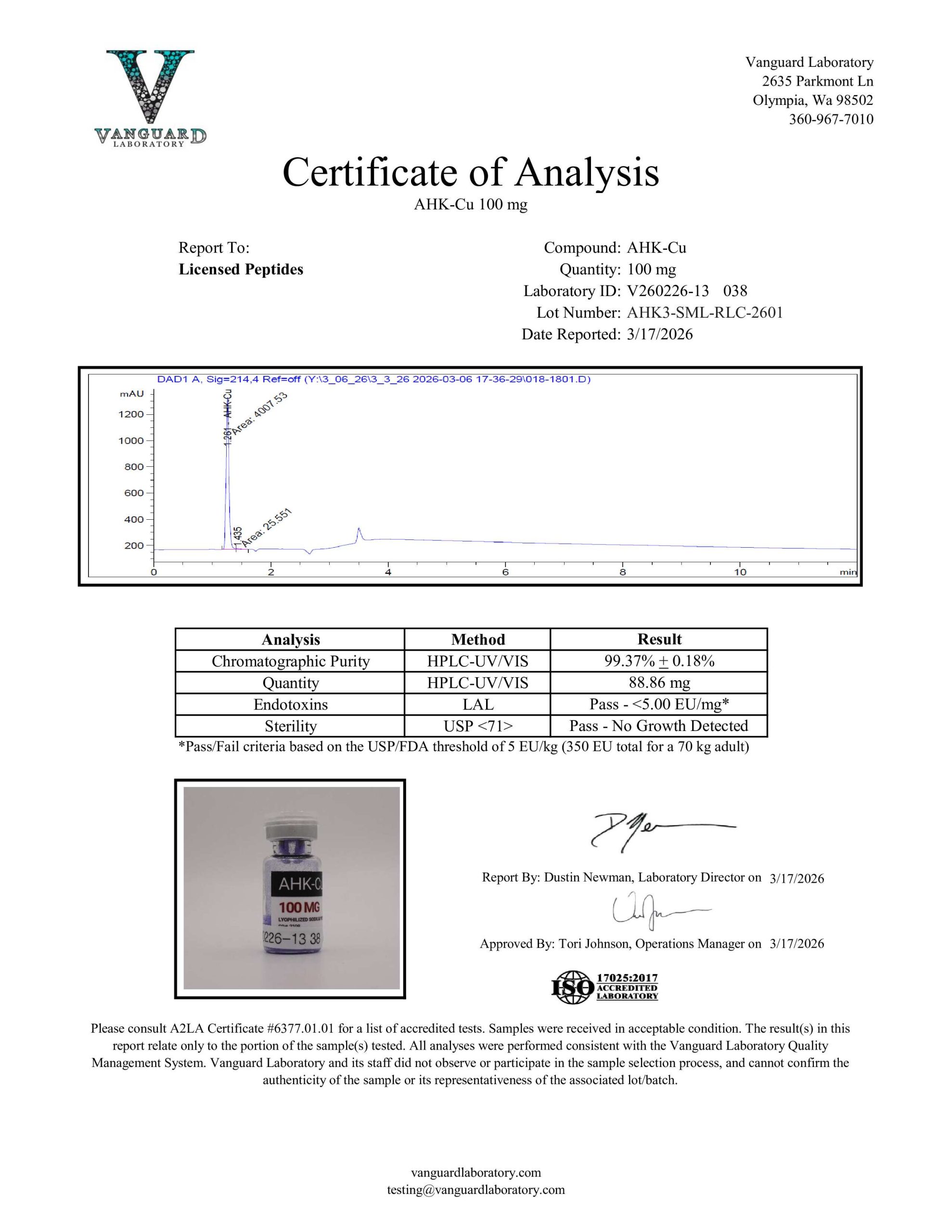
- High-Performance Liquid Chromatography (HPLC): Confirms the purity of the peptide, ensuring it exceeds 98%.
- Mass Spectrometry (MS): Verifies the precise molecular weight and identity of the AHK-Cu complex.
- Elemental Analysis: Confirms the correct ratio of copper chelation within the peptide matrix.
By maintaining these strict quality control measures, Champion Peptides ensures that researchers receive a premium product. It delivers consistent, reproducible results in every experiment.
The 100MG Presentation: Storage and Stability
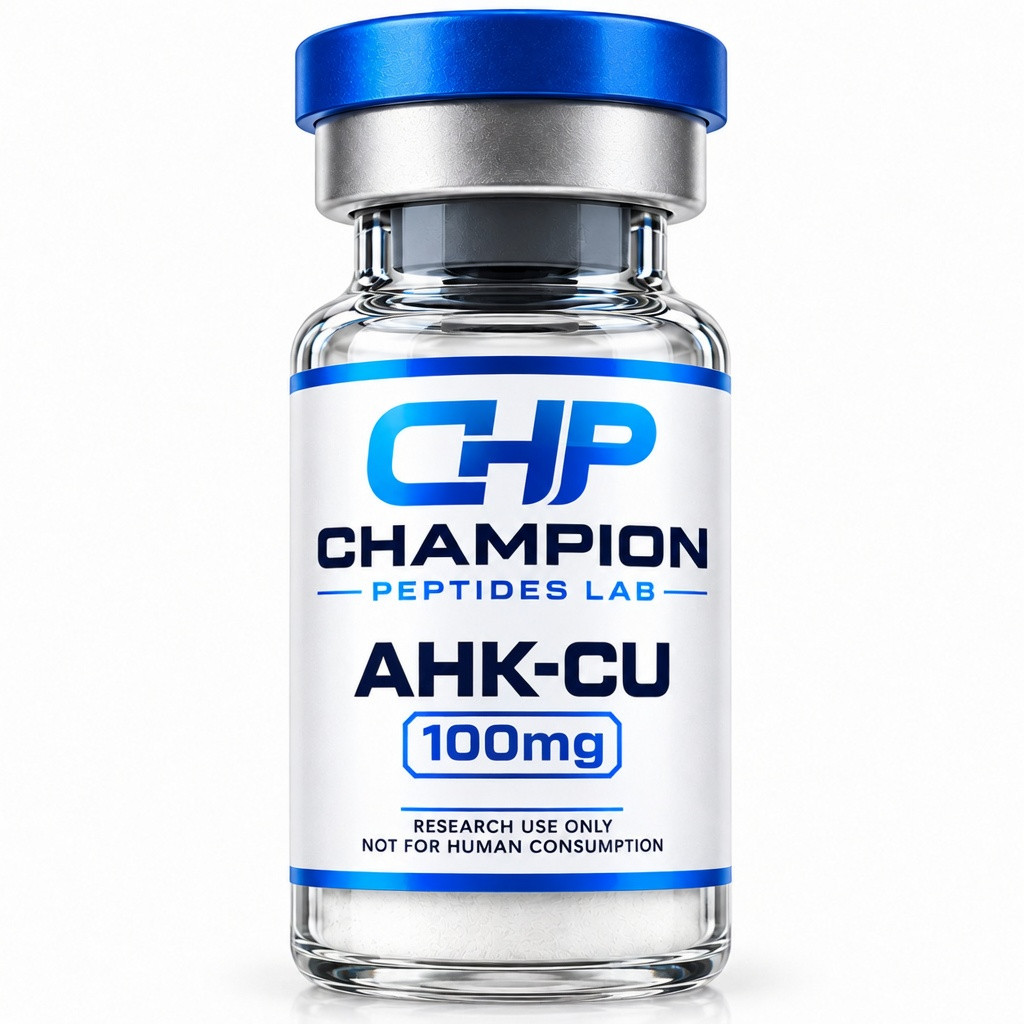
Our AHK-Cu is offered in a 100MG variation. It presents the peptide as a lyophilized—freeze-dried—cake or powder inside a sealed, sterile glass vial. Lyophilization is a preservation process that removes moisture from the product through sublimation. This significantly enhances the chemical stability of the peptide during shipping and long-term storage.
- Lyophilized Storage: For optimal shelf life, store the dry lyophilized powder at -20°C or below. Under these conditions, the peptide remains stable for up to 24 months. If a freezer is unavailable, short-term storage in a standard refrigerator (2°C to 8°C) is acceptable for up to 12 months.
- Reconstituted Storage: Once the peptide is dissolved in a liquid medium, its stability decreases. Reconstituted AHK-Cu should be stored in a refrigerator at 2°C to 8°C and used within 4 to 6 weeks. Avoid repeated freeze-thaw cycles of reconstituted peptide. This can cleave the peptide bonds and dissociate the copper ions, rendering the compound inactive.
Reconstitution and Laboratory Guidelines
To conduct successful research with AHK-Cu 100mg, you must use proper reconstitution techniques. Reconstitution is the process of dissolving the lyophilized powder into a liquid solution suitable for experimental application.
Step-by-Step Reconstitution Protocol
- Acclimatization: Before reconstituting, allow the vial of lyophilized AHK-Cu to reach room temperature. This prevents condensation from forming inside the vial. Condensation can introduce contaminants or degrade the peptide.
- Sanitization: Clean the rubber stopper of the vial with an isopropyl alcohol swab to ensure sterility.
- Solvent Selection: Sterile Bacteriostatic Water (water containing 0.9% benzyl alcohol as a preservative) or sterile phosphate-buffered saline (PBS) is typically used for reconstitution. Bacteriostatic water is preferred if the solution will be stored and used over several weeks, as it inhibits bacterial growth.
- Diluent Injection: Using a sterile syringe, gently draw the desired volume of diluent. Insert the needle through the center of the rubber stopper and slowly inject the liquid down the inner wall of the vial. Do not spray the liquid directly onto the lyophilized powder—rapid physical force can damage the peptide structure.
- Dissolution: Gently swirl the vial in a circular motion until the powder is completely dissolved. Do not shake the vial vigorously. Shaking can cause foaming and lead to the denaturation of the peptide. The resulting solution should be clear. It will exhibit a characteristic light blue or teal tint, which is typical of copper-chelated complexes.
Handling and Dilution Best Practices
To calculate the concentration of your reconstituted solution, divide the total mass of the peptide by the volume of diluent added. Here are two examples:
- Adding 10 mL of bacteriostatic water to a AHK-Cu 100mg vial yields a concentration of 10 mg/mL.
- Adding 5 mL of diluent yields a concentration of 20 mg/mL.
Always perform your calculations prior to reconstitution. This ensures the final concentration aligns with your specific experimental protocols. Use sterile, disposable syringes and needles for all transfers to maintain aseptic conditions in your laboratory.
Why Choose Champion Peptides for Your Research?
When searching for where to buy AHK-Cu, researchers are faced with many options. Champion Peptides stands out as a leading destination for high-purity research compounds. We are committed to supporting the scientific community. We do this by providing top-tier reagents, exceptional customer support, and transparent product verification.
Commitment to Purity and Transparency
We believe that transparency is key to scientific progress. We do not hide behind proprietary blends or unverified claims. Every vial of premium AHK-Cu we ship is backed by authentic analytical data. When you buy AHK-Cu online from Champion Peptides, you can request the corresponding HPLC and MS reports to verify the purity and identity of your specific batch. This commitment ensures that your research budgets are spent on compounds that perform exactly as expected.
Sourcing the Highest Quality AHK-Cu
Our manufacturing facilities use advanced synthesis technologies and operate under strict environmental controls. We source only the finest raw materials. This ensures that our final peptides are free from heavy metals, bacterial endotoxins, and synthesis byproducts. This careful attention to detail results in a highly stable, highly active copper peptide that outperforms lower-grade alternatives. If you are comparing the AHK-Cu price across different suppliers, remember that the true cost of a peptide includes its purity and reliability. Investing in a premium product from Champion Peptides saves time and resources. It prevents failed experiments and inconsistent data.
Key Benefits and Technical Features of AHK-Cu
- Ultra-High Purity: Synthesized to exceed 98% purity, verified by HPLC and Mass Spectrometry.
- Targeted Follicular Action: Specifically optimized to stimulate dermal papilla cells and research hair follicle viability.
- Enhanced Collagen Synthesis: Promotes the upregulation of Type I collagen and structural extracellular matrix proteins.
- Pro-Angiogenic Properties: Stimulates vascular endothelial growth factor (VEGF) to support microvascular remodeling and localized blood flow studies.
- Stable Copper Chelation: Formulated with a precise Alanine-Histidine-Lysine sequence to ensure stable transition metal binding and minimize localized toxicity.
- Convenient 100MG Variation: Vacuum-sealed in lyophilized form for maximum stability, easy reconstitution, and flexible laboratory dosing.
- Reliable Research Resource: Ideal for in vitro assays, cellular proliferation studies, and dermatological tissue modeling.
Comprehensive Purchasing Guide and FAQ
To assist you in your procurement process, we have compiled a detailed overview addressing the most common questions regarding the acquisition, handling, and application of our premium AHK-Cu.
Where is the best place to buy AHK-Cu online?
The best place to buy AHK-Cu online is directly from reputable research chemical suppliers like Champion Peptides. When sourcing peptides online, it is best to avoid marketplace platforms that do not specialize in laboratory reagents. Those products often lack proper quality control, purity verification, and stable cold-chain storage. Champion Peptides specializes exclusively in high-purity research peptides. This ensures that every order is handled, stored, and shipped according to strict scientific standards.
How does the AHK-Cu price reflect its quality?
When evaluating the AHK-Cu price, it is important to understand the costs associated with high-quality peptide synthesis. Cheap peptides are often synthesized using low-grade reagents, abbreviated purification cycles, and minimal analytical testing. This results in products with high levels of impurities, residual solvents, or unchelated free copper.
At Champion Peptides, our pricing reflects the cost of:
- Premium-grade raw materials.
- Multi-step chromatographic purification to achieve >98% purity.
- Comprehensive batch testing (HPLC, MS, and elemental analysis).
- Sterile, lyophilized packaging to ensure long-term stability.
Investing in premium AHK-Cu ensures that your research is built on a solid, reproducible foundation. It saves you from the costly consequences of contaminated or inactive reagents.
What is the recommended storage protocol for AHK-Cu 100mg?
Unopened, lyophilized vials of AHK-Cu 100mg should be stored in a freezer at -20°C or below for long-term preservation (up to 2 years). If the peptide will be used within 12 months, storage in a standard refrigerator at 2°C to 8°C is acceptable.
Once reconstituted with a solvent such as bacteriostatic water or sterile saline, the solution must be kept refrigerated at 2°C to 8°C and used within 4 to 6 weeks. Do not freeze the peptide after reconstitution. The physical stress of freezing can disrupt the copper-peptide bond and degrade the active compound.
Is AHK-Cu suitable for human consumption or clinical use?
No. AHK-Cu sold by Champion Peptides is strictly intended for laboratory research, in vitro studies, and in vivo animal research models. It is not approved for human consumption, clinical diagnostic procedures, or therapeutic use. All research must be conducted by qualified professionals in appropriate laboratory settings. You must use proper personal protective equipment (PPE) and chemical safety protocols.
What is the physical appearance of reconstituted AHK-Cu?
When properly reconstituted with sterile water or saline, AHK-Cu dissolves completely to form a clear, transparent liquid. Because it contains chelated copper ions, the solution will exhibit a distinct, natural light blue or teal coloration. If your reconstituted solution appears cloudy, contains undissolved particulate matter, or lacks the characteristic blue tint, do not use the product. Contact our technical support team for assistance right away.
How can I order AHK-Cu online from Champion Peptides?
To order AHK-Cu online, simply select the 100MG variation on our product page. Choose your desired quantity. Then, proceed to our secure checkout. We offer fast, reliable shipping with protective packaging to ensure your lyophilized peptides arrive in perfect condition. For bulk orders or institutional procurement, please reach out to our customer service department to request a custom quote and discuss specialized shipping arrangements.
Research and Development Outlook
As dermatological and trichological sciences continue to advance, copper peptides remain at the forefront of cellular regeneration research. AHK-Cu—with its highly specific cellular targets—offers an exciting pathway for finding new mechanisms in tissue engineering, microvascular development, and hair follicle biology. By choosing Champion Peptides as your trusted supplier, you gain access to high-quality AHK-Cu for sale. This empowers your laboratory to push the boundaries of scientific discovery with confidence and precision. Optimize your research protocols today. Order your premium AHK-Cu 100mg from Champion Peptides and see the difference that pure quality makes.


There are no reviews yet.