
Description
About CAG-4
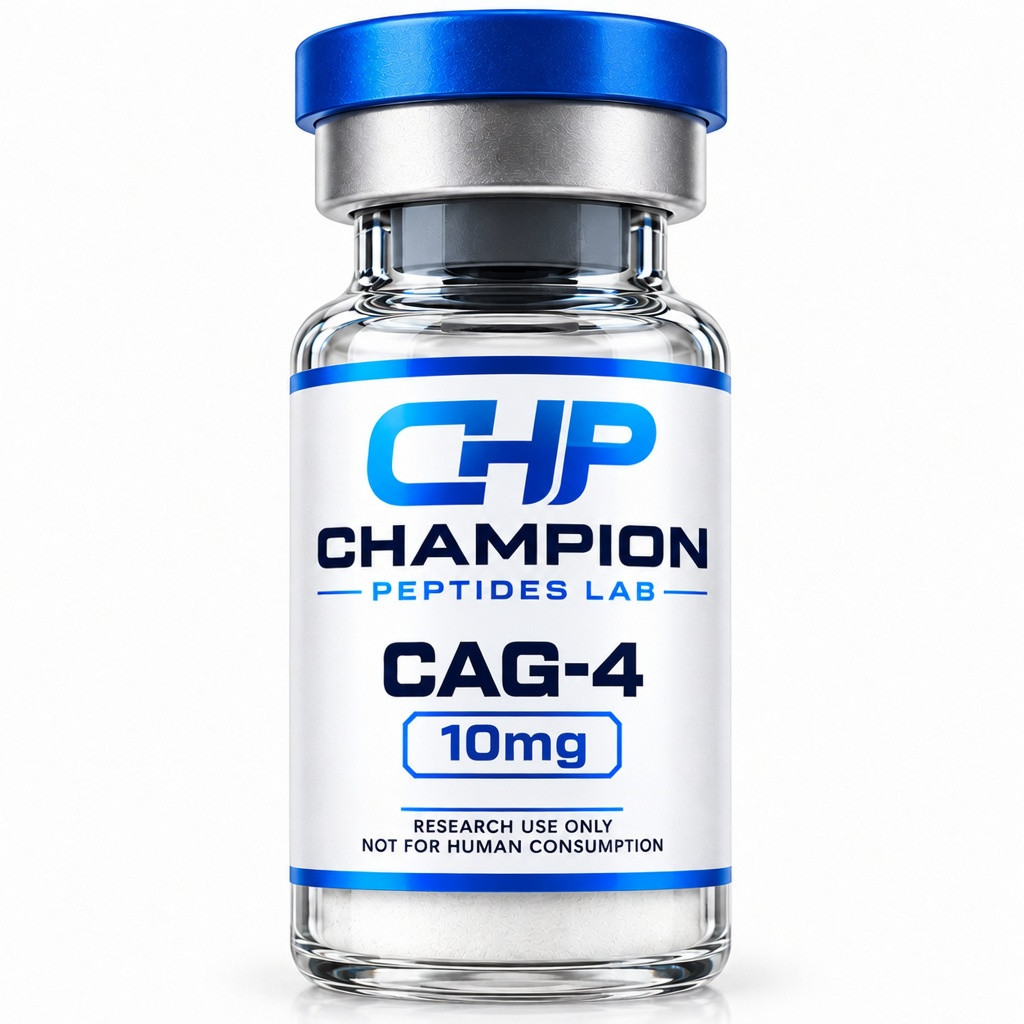
CAG-4 is a lyophilised research compound supplied in 10mg vials for laboratory research programmes. Full specification is confirmed on the batch Certificate of Analysis.
What is CAG-4 studied for?
Research applications are documented in the batch paperwork; contact us for the current COA before ordering.
Specifications
| Compound | CAG-4 |
|---|---|
| Also known as | Research compound CAG-4 |
| CAS number | See batch Certificate of Analysis |
| Form | lyophilised powder, 10mg — confirm specification from batch COA |
| Form | Lyophilised (freeze-dried) powder, vacuum-sealed vial |
| Purity | ≥99% (HPLC), batch COA published |
| Identity | Mass spectrometry confirmed |
| Storage | −20°C sealed; 2–8°C after reconstitution |
| Category | Research Peptides |
Quality and testing
Quality assurance is documented for every batch. Every batch of CAG-4 is tested by HPLC against a ≥99% purity release specification and by mass spectrometry to confirm the molecular identity matches the labelled compound. The batch Certificate of Analysis is published in the test-results library (/test-results/) — the batch number printed on the vial label may be entered there to retrieve the results for that exact batch. In the event that no result is returned, the support team should be contacted via the contact page (/contact-us/) before the product is used, and the discrepancy will be resolved.
This documentation is material to reproducibility. Within the research-peptide market, an identical compound name does not guarantee identical material: synthesis impurities, truncated sequences and degraded stock are not detectable by visual inspection, yet each is identified by an HPLC trace. The release process exists to ensure that the compound recorded in a protocol corresponds to the compound described in the literature being replicated. A full explanation of chromatogram and mass-spectrometry data on a supplier certificate is provided in the guide: How to Read a Peptide Certificate of Analysis (COA) (/blog/how-to-read-a-peptide-coa/).
Why laboratories source CAG-4 from Champion Peptides Lab
Batch-matched documentation. The Certificate of Analysis available at the time of ordering corresponds to the batch dispatched, and the same document is verifiable against the vial upon delivery. Batch numbers are printed on every label and are searchable in the test-results library (/test-results/).
Complete published specifications. CAS number (where assigned), sequence or composition, molecular weight, form and storage are listed on this page and in the accompanying order documentation — the details required for protocols, publications and audits. Should any specification be absent, it will be provided from the batch documentation upon request via the contact page (/contact-us/).
Cold-chain, sealed, tracked dispatch. Lyophilised compounds are vacuum-sealed and stored at −20°C until dispatch, then shipped in discreet, tracked packaging. Every order includes Shipping Protection by default.
Technical and order support. Questions concerning products, documentation, availability and shipping are answered by a support team that works with these compounds daily — Monday to Friday, 9:00 AM–5:00 PM MST. Advice on protocols or applications is outside the scope of support services. This boundary is deliberate, and it is part of the basis on which laboratories rely upon the documentation provided.
Documenting CAG-4 in your research
For laboratory records, cite the compound as: CAG-4, supplied as lyophilised (freeze-dried) powder, vacuum-sealed vial, purity ≥99% by HPLC with mass-spectrometry identity confirmation, batch number as printed on the vial. The batch COA in the test-results library (/test-results/) is the supporting document for that citation. Storage conditions for your materials log: sealed at −20°C, protected from light; reconstituted at 2–8°C.
Storage and handling
Store sealed vials in a freezer at −20°C, protected from light and moisture.
Ordering and delivery — Europe & USA
Orders placed before 12:00 PM MST are dispatched the same business day in discreet, tracked packaging. Delivery within the USA typically takes 2–5 business days. Delivery to Germany, France, Spain, the Netherlands, Italy, Poland, the UK and most of the EU typically takes 5–10 business days — see the country table and customs notes on the Shipping to Europe (/shipping-to-europe/) page. Every order includes Shipping Protection by default, and multi-vial packs (10, 15 and 20 vials where offered) reduce the per-vial cost for extended studies.
Frequently asked questions
What purity is guaranteed for this CAG-4?
Every batch is released at ≥99% purity by HPLC, with identity confirmed by mass spectrometry. The result for the exact batch ordered is published in the test-results library (/test-results/) and may be verified by batch number before or after ordering.
How is a batch verified?
Enter the batch number from the vial label on the Test Results (/test-results/) page to view its Certificate of Analysis.
Is delivery to Europe available for CAG-4?
Yes — tracked, discreet delivery to most European countries and the UK in 5–10 business days. See Shipping to Europe (/shipping-to-europe/) for country-specific delivery times.
What are the storage requirements?
Sealed at −20°C protected from light; after reconstitution, 2–8°C.
What sizes are available?
This page lists the 10mg format. Other sizes of CAG-4, where offered, are linked under Related Products and in the Research Peptides (/product-category/research-peptides/) category.
Research use only: this product is sold strictly for in-vitro laboratory research. Not for human or veterinary use, not for diagnostic or therapeutic use. See the Research Use Only policy (/research-use-only-ruo-policy/).



There are no reviews yet.